


Adventure motorcycle rider aids explained has never been a hotter topic among riders looking for maximum value in today’s booming ADV market. High-tech safety and comfort features are showing up not just on $20,000+ flagship motorcycles, but on mid-range adventure bikes as well. Should you pay up for semi-active suspension, advanced traction control, and bike computers—or can you skip some of the electronic wizardry to save a serious chunk of change? Let’s break down which rider aids actually deliver results where it matters: on the road, on the trail, and in your wallet.
Key Takeaways
- Flagship adventure motorcycle tech—like semi-active suspension and lean-sensitive traction control—is becoming available on mid-range ADV bikes, but not every feature has the same real-world value.
- Understanding how ride modes, IMU-based traction control, and electronic suspension work helps you avoid overspending on “nice to have” extras.
- Careful feature selection lets hands-on ADV riders enjoy safety and comfort improvements…without paying for tech you’ll never use in everyday riding.
Table of Contents
Why Rider Aids Matter More Than Ever on Mid-Range ADV Bikes
Five years ago, electronic rider aids were nearly exclusive to top-dollar adventure bikes or exotic European machines. Now, competitive mid-market models from brands like Yamaha, Honda, KTM, and CFMOTO offer a stunning suite of features once reserved for luxury flagships. Features such as throttle-by-wire, selectable ride modes, IMU-based traction control, cornering ABS, quickshifter, hill start assist, and even electronically adjustable semi-active suspension aren’t just luxury items—they can be essential aids for road safety and long-haul comfort.
Still, “more tech” doesn’t always mean “better ride.” Realistically, not every motorcycle rider will use every function in the same way. That’s why understanding adventure motorcycle rider aids explained makes all the difference: It lets you buy smart, choose the aids that add real value for your rides, and skip the ones that don’t fit your riding style or budget.

According to GearJunkie, modern adventure bikes now rival superbikes by offering “throttle-by-wire, quick shifter, hill start control, lean angle-sensitive cornering ABS, selective ride modes, adaptive cruise control, and electronically adjustable semi-active suspension.” Yet with choice comes complexity: not all features benefit all riders—or even every type of terrain.
Ride Modes, Traction Control, and ABS: What Do They Actually Do?
What does it mean when a manufacturer promises five ride modes, multi-stage traction control, and advanced ABS? Here’s the ADV bike traction control modes explained—boiled down:
- Ride Modes: Most mid-range ADV bikes come with multiple selectable ride modes (ex: Sport, Street, Rain, Off-Road). One button adjusts the entire “personality” of the bike by changing throttle response, power output, traction control sensitivity, ABS intervention, and suspension stiffness (if electronically adjustable). This gives you fast, one-click adaptation to highway, rain, loose gravel, or deep sand. Some bikes, like the KTM 890 Adventure, bundle electronic suspension “soft/firm” settings into each ride mode.
- Traction Control: Modern systems are light-years ahead. Using a six-axis inertial measurement unit (IMU), these bikes monitor lean angle, wheel slip, and throttle input. The bike computer automatically modulates engine torque—in milliseconds—to keep the rear wheel from spinning out. Many ADV bikes also offer several traction control “levels,” so you can fine-tune slip allowance for deep sand versus fast gravel or tarmac (learn more about traction control logic).
- CBS and Cornering ABS: Standard anti-lock brakes (ABS) keep wheels from locking. More advanced “cornering ABS” uses IMU data to moderate brake pressure even while the bike is leaned over, massively improving safety during emergency stops on twisty roads.
Fact: “Modern traction-control systems use a six-axis inertial measurement unit to monitor lean angle, wheel slip, and throttle input, and can intervene by reducing engine torque in milliseconds.”
One common pitfall: Some lower-cost adventure bikes include only the most basic ABS or non-IMU traction control. Check before you buy—“lean-sensitive” systems provide far more real-world safety, especially on varied terrain.
Semi-Active Suspension: What It Is and Who Needs It
Semi-active suspension motorcycle tech was once the hallmark of $20,000+ Euro bikes. Today, high-end features like electronically adjustable semi-active suspension and adaptive ride height are trickling into mainstream adventure motorcycles—like the Harley-Davidson Pan America, KTM 890/1290 Adventure lines, and BMW GS models. But what is it… and does it matter for you?
- Continuous Damping Adjustment: With semi-active systems, sensors constantly track wheel travel, bike speed, chassis movement, road texture, and load. The SCU (suspension control unit) modifies compression and rebound damping on the fly—hundreds of times per second (read about KTM’s SAT).
- Auto Preload and Adaptive Ride Height: Rear shock preload can be “dialed in” automatically by the bike for solo, two-up, or fully loaded scenarios. Some systems will lower the bike at stops, making it much easier to put your feet down—then raise it at speed for ground clearance (see Harley’s Pan America example).
- Direct Adjustment On the Go: No tools, no stopping. Pick “Soft” for rough roads and “Hard” for high speeds—from the dash.
“Semi-active suspension found on high-end ADV models continuously reads sensors and adjusts damping up to hundreds of times per second based on road and riding input. Rear spring preload can also be altered electronically.” These benefits shine for all-day comfort on changing surfaces, especially when mixing highway, dirt roads, and abrupt pavement patches.
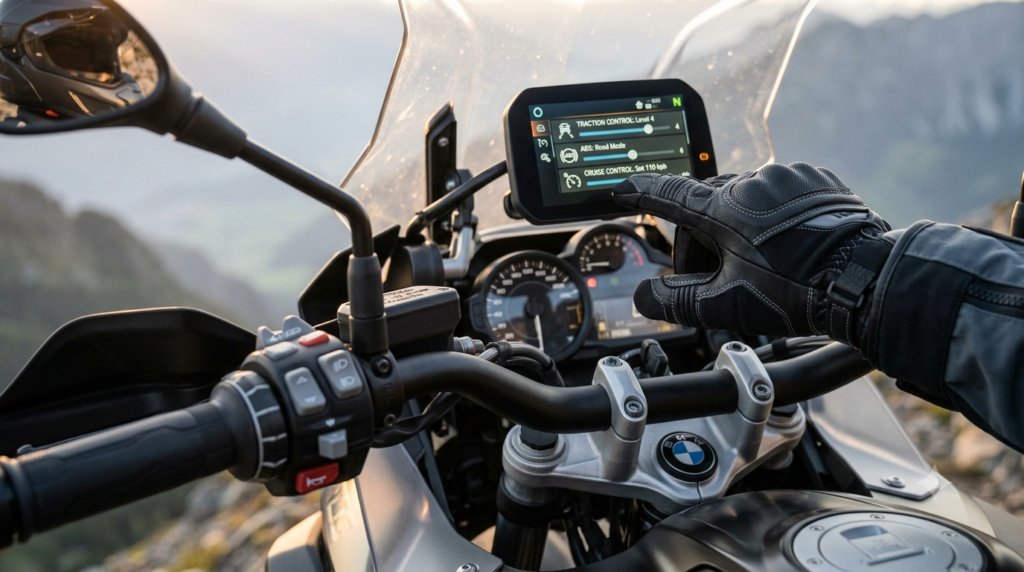
Downsides to consider: Semi-active suspension doesn’t add ground clearance, increase suspension travel, or replace the basics of good setup. As this guide explains, it’s no substitute for correct weight tuning and can’t magically “fix” a fundamentally under-sprung bike. If saving weight or ultimate offroad simplicity matters, a high-end manual suspension might be the smarter bet.
Quickshifters, Cruise, and Hill Start: Which Extras Make a Real Difference?
Beyond the “big three” electronic aids, many mid-range adventure bikes increasingly offer features that were strictly luxury just a few years ago. Is a Quickshifter ADV bike worth chasing? What about hill start and adaptive cruise?
- Quickshifter: Allows clutchless upshifts (and often downshifts) for smoother, faster gear changes—especially handy in standing dirt climbs or big, fast elevation changes on-pavement. Not essential, but great for fatigue reduction on long tours.
- Hill Start Control: Lets you stop on a steep incline, take your hands off the brakes, and pull away with no rollback—very handy when riding loaded or two-up.
- Adaptive Cruise Control: Maintains speed and following distance automatically—even reducing throttle/braking as you approach cars. Pricier, but a game-changer for riders doing long highway sections between dirt or BDR routes.
“High-end ADV models offer quick shifter, hill start control, and adaptive cruise control; these features…are often cited as game-changers for long adventure travel.” (GearJunkie)
Should every rider demand these? Not always. For core adventure, comfort features like quickshifter and cruise matter most to those who log hours in the saddle every day. If you mostly travel shorter distances or love “old-school” clutch feel, these add cost with limited payback. If you’re an all-weather commuter or cross-country rider, they pay dividends in comfort and fatigue reduction.
Want more ways to improve ride comfort and safety on long tours? Check out our guides to heated vests, electronic earmuffs, or soft panniers for adventure motorcycle
How to Decide: Which Tech Is Worth Paying For?
Here’s where the rubber meets the road. With so many electronics available, how should mid-market ADV buyers approach the feature list?
- Start with tech that fits your intended use. If most of your riding is mixed-surface, ride modes and lean-sensitive (IMU-based) traction control/ABS deliver real benefits. If you’re a technical trail devotee, sometimes less is more—basic ABS with off-road mode may be all you want.
- Understand limits: Even the latest semi-active suspension manages damping only. It doesn’t add suspension travel or traction. For rough BDRs, set spring preload manually to match your weight—then let the electronics fine-tune at the margins.
- Prioritize convenience aids—like quickshifter or adaptive cruise—if you regularly do long highway stints, or have a medical reason to reduce hand fatigue.
- On a tight budget? Focus your dollars on core safety and comfort, not every possible electronic bell and whistle.
| Rider Aid | Best For | Possible Downsides | Worth the Extra? |
|---|---|---|---|
| Ride Modes & IMU Traction Control | Mixed surfaces, variable weather, ADV touring | Complex menus, possibility of distraction | Yes, for most riders |
| Semi-Active Suspension | All-day comfort, heavy loads, mixed routes | No extra suspension travel, more complexity can mean higher repair costs | Worth it if terrain and comfort variable |
| Quickshifter | Long touring, technical climbs, riders with hand fatigue | Can feel “disconnected” to purists, some systems lack smoothness at low RPM | Optional unless highway/distance is your focus |
| Adaptive Cruise, Hill Start | Highway travel, heavy or two-up bikes | Added weight and electronics, price bump | Nice-to-have, not essential |
Want even deeper dives into ADV gear? Read our take on beginner-friendly mid-size adventure motorcycles, ultralight adventure motorcycle camping gear, or the rally raid adventure motorcycle gear essentials for off-grid trips.

Conclusion
Flagship electronics are no longer just for ultra-premium bikes. But with adventure motorcycle rider aids explained, it’s clear that more isn’t always better. Key takeaways: Get IMU-based traction control and well-mapped ride modes for maximum real-world value. Consider semi-active suspension and comfort/convenience aids if you’ll benefit from them—but don’t feel obligated to max out the spec sheet. The best ADV bike is the one that fits your riding style, your budget, and lets you focus on the next trail, not your dash menu. Want more hands-on buying guides and tech breakdowns? Subscribe or check our full archive below!
FAQ: Adventure Motorcycle Rider Aids
What is the most important electronic rider aid for adventure motorcycles?
For most riders, lean-sensitive traction control (IMU-based) and selectable ride modes add the most safety and confidence, especially on changing surfaces and mixed weather. Electronic suspension and comfort aids are good bonuses, but not essential for everyone.
Is semi-active suspension worth paying extra for?
It depends on your riding. If you spend a lot of time on long tours or ride with varying loads, semi-active suspension’s real-time adjustment makes a big comfort difference. Pure off-roaders or budget-minded riders may prefer a well-tuned manual setup.
Can I add advanced electronic rider aids to an older adventure bike?
Most modern systems like IMU traction control and semi-active suspension are deeply integrated into the bike’s design and electronics—retrofits are rare and impractical. Add-ons like heated grips, auxiliary lighting, or phone-based navigation are usually easier to fit.
Are quickshifters reliable on adventure bikes?
Modern quickshifters are generally reliable but do introduce a bit more mechanical and electrical complexity. Maintenance and occasional recalibration help. If you’re riding in remote areas, know how to ride without it in case of malfunction.
Do I need all these electronics if I mostly ride off-road?
Not always. Hardcore off-roaders often prefer minimal electronics—basic ABS with an off-road mode, or simple traction control, can be enough. Electronics shine most for touring, travel, and varied conditions.