
Table of Contents
Lightweight motorcycle camping gear is the game-changer that separates a slogging trip from true motorcycle freedom. If you’re tired of wrestling with bulky bags and gear that eats up your pannier space, this guide will show you down-to-earth, field-tested strategies to minimize weight and maximize your fun—without sacrificing comfort, warmth, or real-world safety.
Key Takeaways
- Packing ultralight for moto camping makes technical terrain easier and reduces fatigue on long days.
- Modern gear lets you get a full sleep, cook, and stay comfortable in under 25 lb total pack weight.
- Precise organization and double-use items are your secret weapons for making compact kits work.
- Why Go Light? The Real-World Benefits of Lightweight Motorcycle Camping Gear
- Ultralight Sleep Systems—Modern Solutions for Moto Campers
- Cooking & Camp Comfort—Eat Well With Minimal Bulk
- Organization & Luggage—Packing Smart for a Compact Beta
- Must-Have Lightweight Motorcycle Camping Gear List (Editor’s Picks)
- Tips From the Ultralight Riders’ Community
- Advanced Analysis & Common Pitfalls
- Conclusion
- Frequently Asked Questions
Why Go Light? The Real-World Benefits of Lightweight Motorcycle Camping Gear
Packing light for motorcycle camping isn’t about joining a minimalist cult—it’s about practical advantages on real dirt and twisty tarmac. A lighter bike handles better, especially through sand, mud, or steep switchbacks. Less gear means less physical stress, less risk of drops, and more freedom to explore remote spots out of cell range. Compact, lightweight motorcycle camping gear cuts fatigue so late-day mistakes are less likely, and you’ll actually enjoy the setup process at camp.
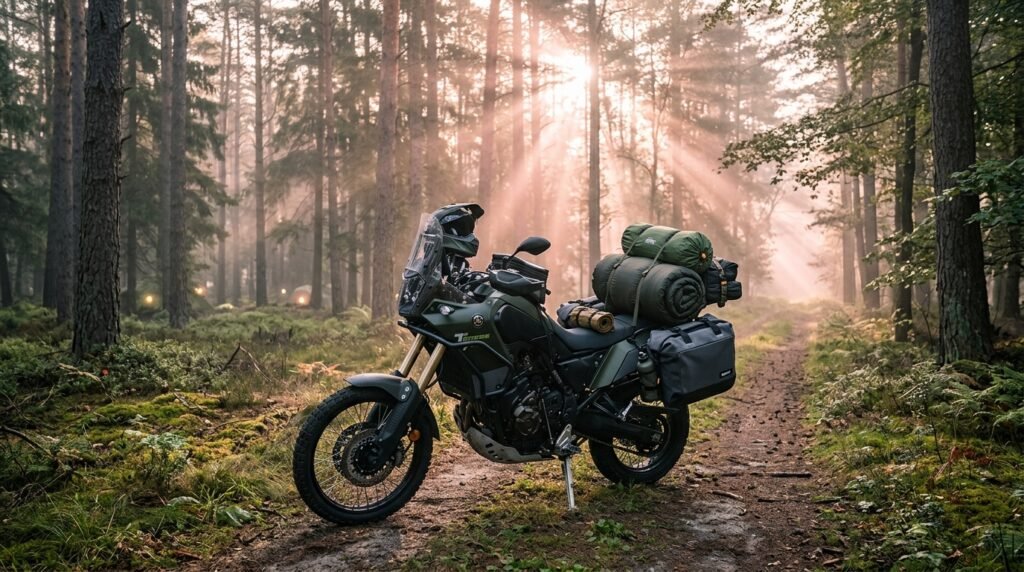
Data backs up the switch to light-and-tight setups. As one rider puts it: “On easier routes, pack for comfort. But in sand and technical terrain, a lighter bike is easier to manage and more fun to ride.” (Source).
Ready to upgrade how you roll? Let’s get specific about the building blocks of a pack-light motorcycle camping adventure.
Ultralight Sleep Systems—Modern Solutions for Moto Campers
Gone are the days when camping light meant a rough night’s sleep. Ultralight moto setups today focus on a sub-5 lb, sub-10L sleep kit that rides small, stays warm, and sets up fast—critical for solo and ADV travel.
- Shelter: A one-person tent like the MSR Hubba Hubba is a proven mix of comfort and weight (see Moto Camp Nerd). If you want to go even lighter and can handle tight quarters, a bivy sack is practically invisible in your luggage.
- Quilt or Bag: Quilts like the Sea to Summit Ember Down or Nemo Pulse pack easier than old-school sleeping bags and adapt to various temps. Make sure you get one with a roomy footbox if you dislike being wrapped tight.
- Pad: Modern ultralight pads (Sea to Summit Ultralight Mat: 382g/13.5oz) roll to under a liter in volume yet still insulate and cushion rough ground. Always bring a tiny repair kit with inflatable pads.
- Pillow: Quick-inflate or stuffable, under 3oz. Some use spare clothes as a pillow to save grams.
With careful choices, “a full Nemo Equipment sleep kit—tent, pad, pillow, and 20° quilt—packs to about 10L at just over 4 lbs” (Source).
Cooking & Camp Comfort—Eat Well With Minimal Bulk
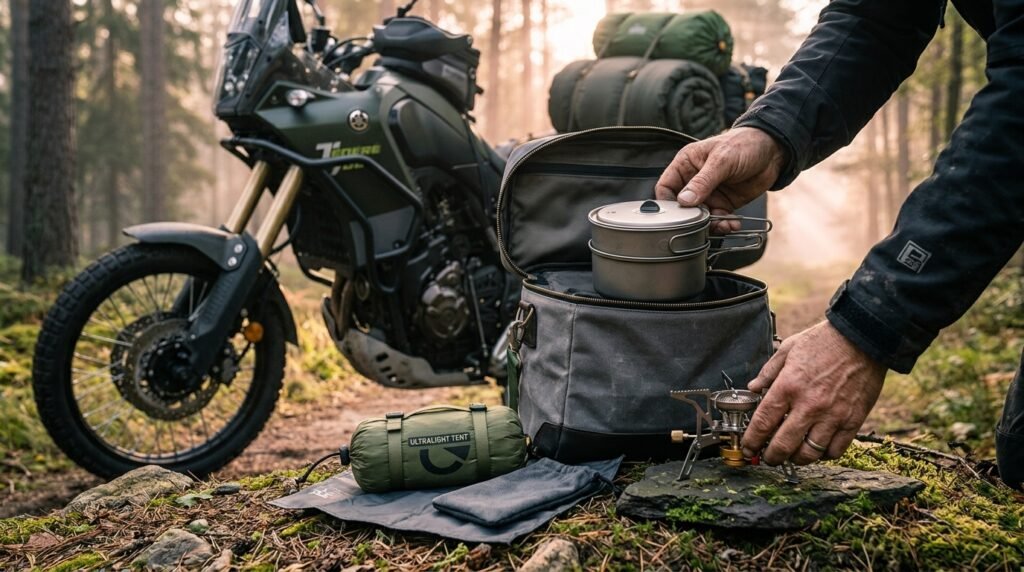
Smart packing for the kitchen and camp extras means you can eat well and relax without a sprawling gear bomb in your luggage.
- Stove & Cookware: Go for proven compact stoves like the Optimus Crux (±100g) or Jetboil Flash (see review). Combine these with a Sea to Summit Frontier kit or a titanium pot with fold-away handles for meals, coffee, and boil-in-bag solutions.
- Utensils: Choose a titanium spork or a 2-piece aluminum folding set. Multi-use utensils (spork + bottle opener) trim weight and cost.
- Lighting & Power: Rechargeable headlamps (like the Black Diamond Spot 400-R) eliminate one-use batteries. A solar lantern, such as the LuminAID PackLite Titan, provides ambient light for a fraction of the bulk.
- Comfort Extras: The lightest chairs like the Big Agnes Skyline UL (just over a pound) fold down tiny and offer back-saving relief after technical riding days.
- Other Essentials: For insect-heavy areas, pack a mosquito repellent and consider a small tarp or ultralight netting.
Match your food strategy to your kit—freeze-dried or no-cook packets are easiest to clean up and pack out, while coffee drinkers should look for collapsible pour-over filters.
Want a kitchen that’s even more beginner-friendly? Try a dual fuel camping stove for hassle-free roadside fueling.
Organization & Luggage—Packing Smart for a Compact Beta
The smartest lightweight motorcycle camping gear won’t help if it’s scattered or awkward on your bike. The final step is organization and smart luggage strategy.
- Panniers & Duffels: A dedicated bikepacking system (like Kriega OS panniers or Mosko Moto Alpine duffel) distributes weight low and forward for better handling.
- Stuff Sacks & Compression: Use zip-closure sacks and waterproof compression sacks to minimize volume and keep items dry—even in a soft pannier. Compress sleeping gear and clothing down to the absolute minimum.
- Luggage Setup: For a holistic packing plan, check out this guide on motorcycle camping luggage setup and another on soft panniers for adventure motorcycles.
- Pack Weight: Advanced setups get all camping gear, clothing, and food under 20–25 lb (excluding water/fuel).
- Modular Kits: Modular packing cubes and dedicated gear organizers make route changes or camp setups much easier. See the Moto Pockets Stuff Bags for ideas.
Use your tank bag and pannier lids for quick-access safety and repair kits. If you ride in wet zones, look for waterproof panniers or line your bags with trash compactor bags for redundancy.
Must-Have Lightweight Motorcycle Camping Gear List (Editor’s Picks)
Below is a fully actionable, handpicked gear list for lightweight or ultralight ADV camping. It has options for different budgets and riding scenarios:
| Gear Category | Product Example | Weight/Volume | Notes |
|---|---|---|---|
| Tent/Shelter | MSR Hubba Hubba / Alps Mountaineering Zephyr 1P / Bivy Sack | 2.5–3.5 lb (1.1–1.6 kg) / 3-5L | Freestanding; bivy is lighter but less roomy |
| Quilt/Sleep Bag | Sea to Summit Ember Down Quilt / REI Magma | 1–1.5 lb (450–700g) / 2–3L | Quilt is more compact, adapts better to wide temps |
| Sleeping Pad | Sea to Summit Ultralight Mat / Big Agnes Rapide SL | 382g / 13.5 oz / under 1L packed | Repair kit is critical for inflatables |
| Camp Chair | Big Agnes Skyline UL Chair | 32oz / just over 1lb | Optional, but adds big comfort value |
| Cooking System | Optimus Crux / Jetboil Flash / Dual Fuel Stove | 100g (stove only) / Small canister or liquid | Choose based on fuel access |
| Utensils | Titanium Spork / Folding 2-piece | 30g or less | Multi-use if possible |
| Lighting | Black Diamond Spot 400-R / LuminAID Titan | Headlamp ~3oz / Lantern ~8oz | Rechargeable only |
| Luggage | Kriega OS, Mosko Moto, Moto Pockets Cubes | Variable | Keep total camp load under 25 lb for best performance |
Need a leg up on safe packing and gear checks? Start with this adventure motorcycle camping checklist and update your kit as you gain experience.
Tips From the Ultralight Riders’ Community
The best lightweight motorcycle camping gear setups evolve through field use and feedback. Here are field-tested lessons and real-world tips:
- “Every piece earns its spot.” Don’t pack a gadget for ‘what if’ unless it genuinely saves your trip. Redundancy is critical for repair and safety but skip luxury backups.
- Replication matters: Bring minimal repair kits—not just for the bike, but for inflatable pads, tent poles, and zippers. Review options for a tire repair kit tailored to your ADV bike.
- Double-use: A puffer vest, for example, works for both riding insulation and pillow duty (packable down jacket guide).
- Test your kit at home or on a micro-adventure before a big trip. You’ll quickly spot what’s wasted weight and what’s a must-have.
- This kind of setup, “isn’t for every trip.” Pack light when trails, sand, or technical terrain are the main dish—but don’t beat yourself up if you want a luxury or two for comfort on easy routes (Source).
Want pro-level modular organization? Modular stuff bags and cubes—see adventure motorcycle camping gear—let you tweak for any trip, not just featherweight ADV outings.
Advanced Analysis & Common Pitfalls
Even with the best lightweight motorcycle camping gear, a few mistakes can make or break your trip. Here’s what to avoid, and how to compare gear realistically:
| Pitfall | What Happens | Solutions |
|---|---|---|
| Sleeping Pad Failure | Cold, uncomfortable night if pad leaks/deflates. Delayed recovery for next day’s ride. | Take a micro repair kit; test inflation before trip. |
| Choosing Ultra-Mini Bivy | Claustrophobic or soaked if sudden heavy rain/off-camber site. | Try setups at home, have tarp backup for bivies. |
| Food Storage | Attracts animals, spills in panniers. | Bear-proof canisters or odor-proof bags for certain regions. |
| Overcomplicating the Kitchen | Multiple pots/pans or big stoves add weight and fuss. | Stick to one-pot meals and a single lightweight burner. |
| Insufficient Rain/Ground Protection | Soaking wet sleep kit or gear failure in sudden storm. | Use footprint/tarp; waterproof compression bags; check packing guides on laminated waterproof motorcycle luggage. |
Conclusion
Going ultralight with your motorcycle camping setup can transform both the ride and the overnight experience. By dialing in your lightweight motorcycle camping gear, you’ll gain handling, comfort, and confidence for backcountry ADV routes, remote forest tracks, or even quick overnight escapes. Start small, test your kit, and discover what you really don’t need—then invest in the key pieces that fit your riding style and destinations. Ready to ride light, camp smarter, and maximize every mile? Start updating your kit today and feel the freedom on your next trip.
What’s your go-to trick or game-changing piece of lightweight gear? Share it in the comments below or check our in-depth guides to adventure motorcycle camping on cometoride.com.
Frequently Asked Questions
What is the ideal total weight for ultralight motorcycle camping gear?
For most solo riders, a total pack weight (including sleep, kitchen, clothing, and essentials) of around 20-25 lb is ideal. This keeps your bike nimble and reduces fatigue over long technical days.
How do I repair an inflatable sleeping pad on the trail?
Always carry a micro repair kit (usually supplied with premium pads). Clean the area, use the adhesive patch, and let it cure fully before re-inflating. Practice at home before relying on this in the wild.
Are bivy sacks comfortable for extended motorcycle trips?
Bivy sacks are the lightest and most compact option, but they can be confining for some. Test at home for fit and condensation. Always bring a backup tarp if rain or poor site selection could be an issue.
What’s the best way to keep my gear dry?
Use waterproof compression sacks and line panniers with compactor bags. For full confidence, invest in waterproof panniers or duffels with welded seams.
How can I pack a kitchen for two people without adding much weight?
Opt for one compact stove and a mid-size titanium pot. Share utensils and lighting. Plan no-cook breakfasts and one-pot dinners to keep bulk and cleanup minimal.
—